VAULT ACCOUNTRITUALS STRATEGYWATCHERS OMENSORACLE PLANWARDS LAWHIGH SEAL EXECUTE
Trading operations / AI planning / broker-safe execution
Glyph trading operations platform
Glyph is a broker-connected trading terminal built around one Alpaca account, virtual strategy sleeves, auditable
ledgers, deterministic risk controls, AI-assisted planning, backtesting, and production operations. The product
language is dark fantasy; the implementation underneath is boring on purpose: FastAPI, Python services, JSON/JSONL
ledgers, Prefect schedules, Alpaca adapters, and Wards that can say no.
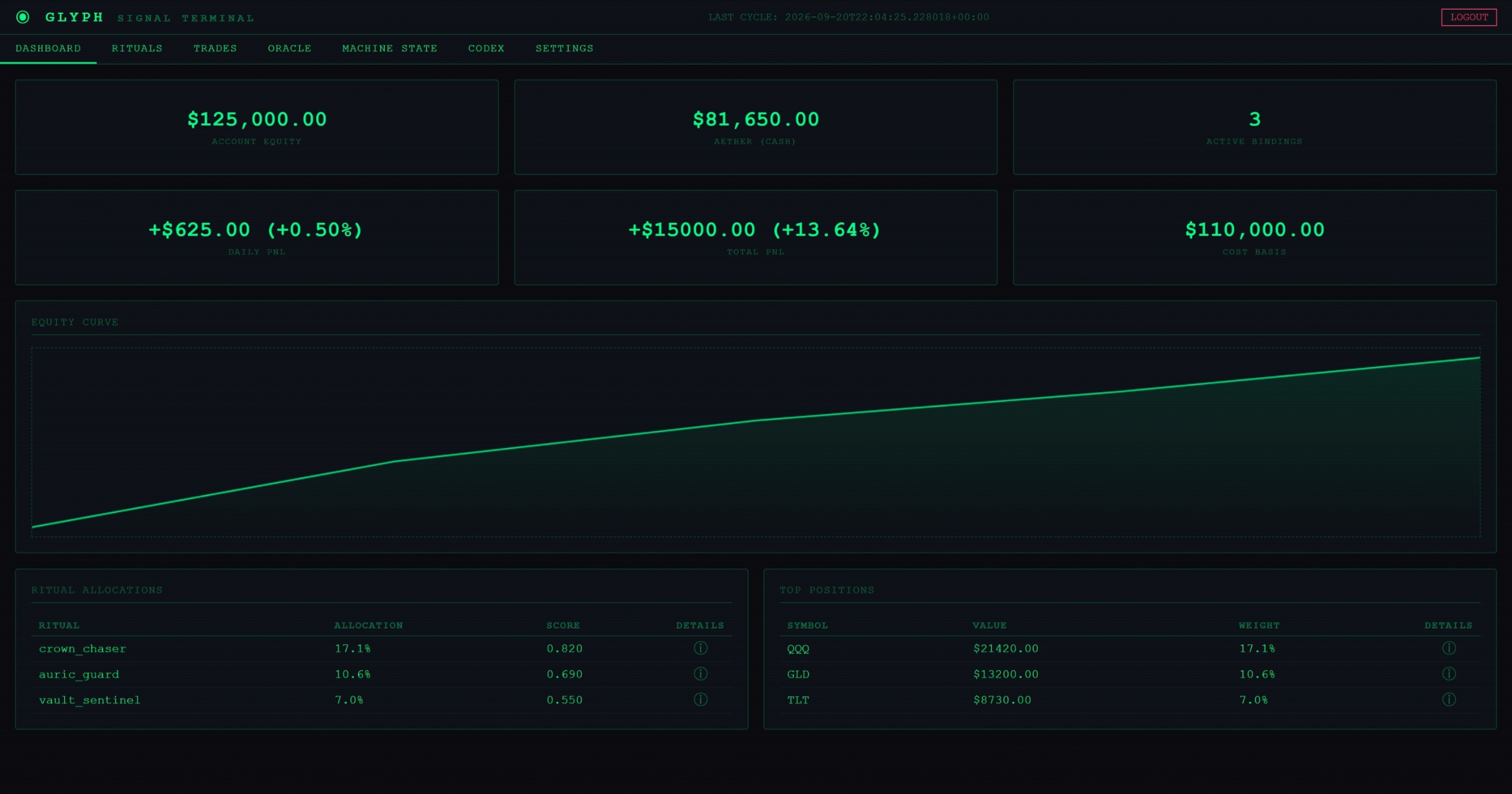
Dashboard with demo account data: account totals, strategy allocations, and positions share one operator view. Displayed returns are simulated, not investment results.
What it solves
The design problem was not how to make a trading app look unusual. It was how to give an operator a system that can
combine strategy construction, market research, AI planning, risk review, broker execution, and recovery without
hiding who owns a position or why an action happened.
I designed the UI and application model around separation of authority: Rituals express desired exposure, Watchers
detect Omens, the Oracle and AI Mind propose plans, Wards enforce deterministic law, Manifestation converts approved
targets into broker-safe orders, and Chronicle records the chain.
Wardsdeterministic veto
freshness, exposure, cash, High Seal
01
Vault
One Alpaca account becomes a portfolio view with Aether, broker snapshots, allocation ledgers, positions, owner splits, and PnL attribution.
02
Rituals
Strategies are virtual sleeves with allocation, lifecycle state, holdings, watcher context, Oracle policy, and Manifestation targets.
03
Terminal
A read-only operator console exposes status, cycles, logs, Ritual books, broker snapshots, decisions, and stored files.
04
Backtesting
Divinations test swing, intraday, strategy-block, cross-asset, and watcher-specific ideas before they can approach execution.
Oracle
The Oracle researches, summarizes, proposes, and explains. It can route market evidence into structured plans, but it
cannot call the broker, claim execution happened, or bypass deterministic Wards.
Provider fallback, prompt budgets, circuit breakers, and confidence thresholds.
Market research from configured search and macro sources.
Typed AITradingPlan output instead of raw buy or sell commands.
Watchers
Watchers are scouts. They observe data health, market regime, volatility, macro liquidity, theme risk, crypto state,
and strategy-specific Omens, then wake the Mind or inform dashboard context.
Theme watchers for miners, black soil, nuclear, AI grid, gold, crypto, and defense.
Runtime intervals, stale-event routing, and stream health checks.
No direct trading authority.
Wards
Wards are final law. They enforce position caps, turnover caps, minimum notional, cash buffer, context freshness,
cross-sleeve exposure, regular-hours rules, broker preflight, idempotency, and the High Seal.
AI confidence cannot override deterministic checks.
Broker orders require the execution target and High Seal to be valid.
Blocked plans remain auditable instead of disappearing.
Planning pipeline
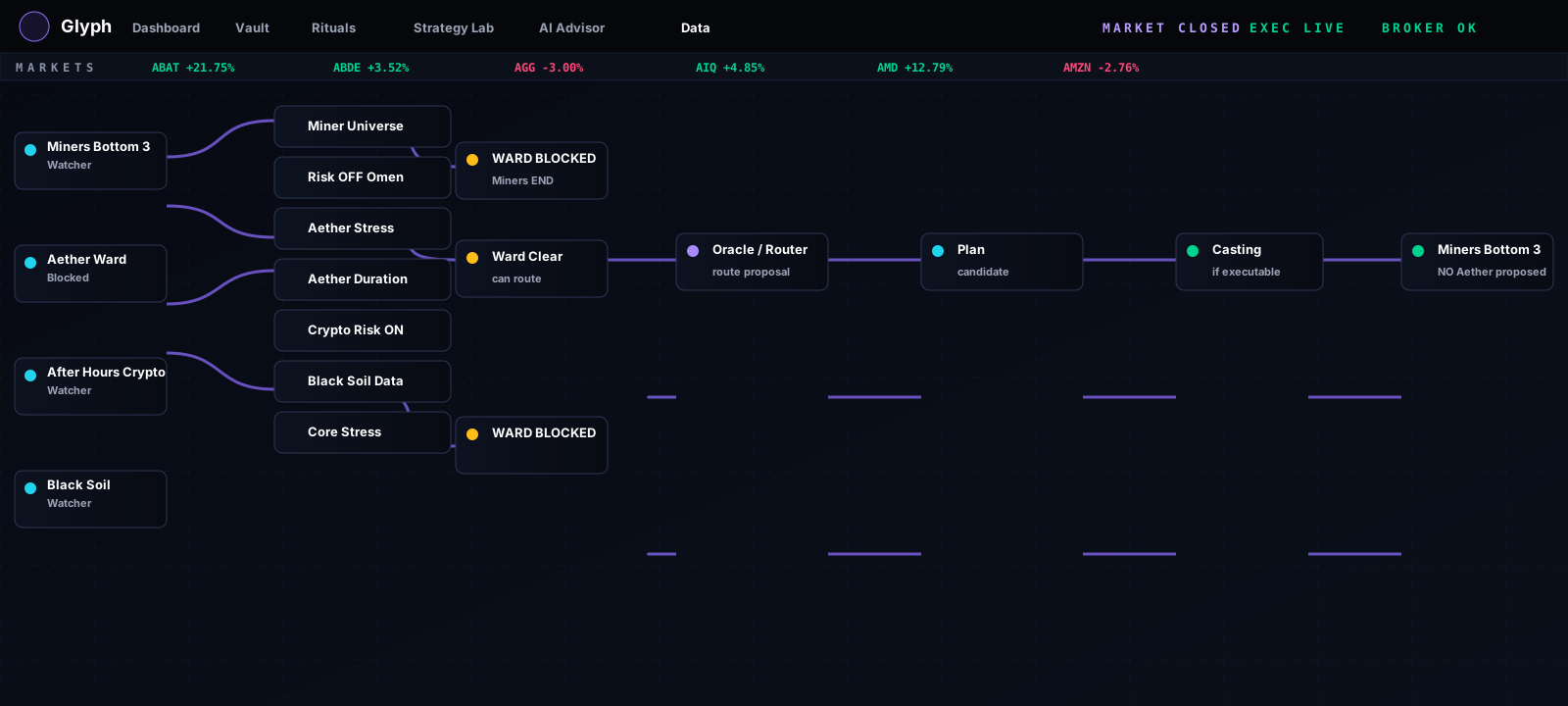
AI can scout and plan, but execution stays typed, clipped, and reconciled.
Market dataWatchers emit OmensResearch adds evidenceAI Mind plansWards validatePlanner creates intentsBroker or SimBroker executesChronicle records
Strategy construction
Sigils - composed strategy trees made from deterministic blocks.
Glyphs - reusable conditions, filters, weights, branches, and asset nodes.
Runes - computed metrics such as SMA, RSI, VWAP, volatility, and drawdown.
Omens - market, watcher, or context events that influence planning.
Rituals - deployable sleeves that turn strategy output into target books.
Execution safety
Manifestation - compares desired Ritual books to actual broker positions.
High Seal - kill switch that gates paper and live broker orders.
Ownership ledger - records opened, closed, and migrated position ownership events.
Reconciliation - checks broker state after execution and supports recovery.
Chronicle - preserves decisions, Wards, orders, ownership, and outcomes.
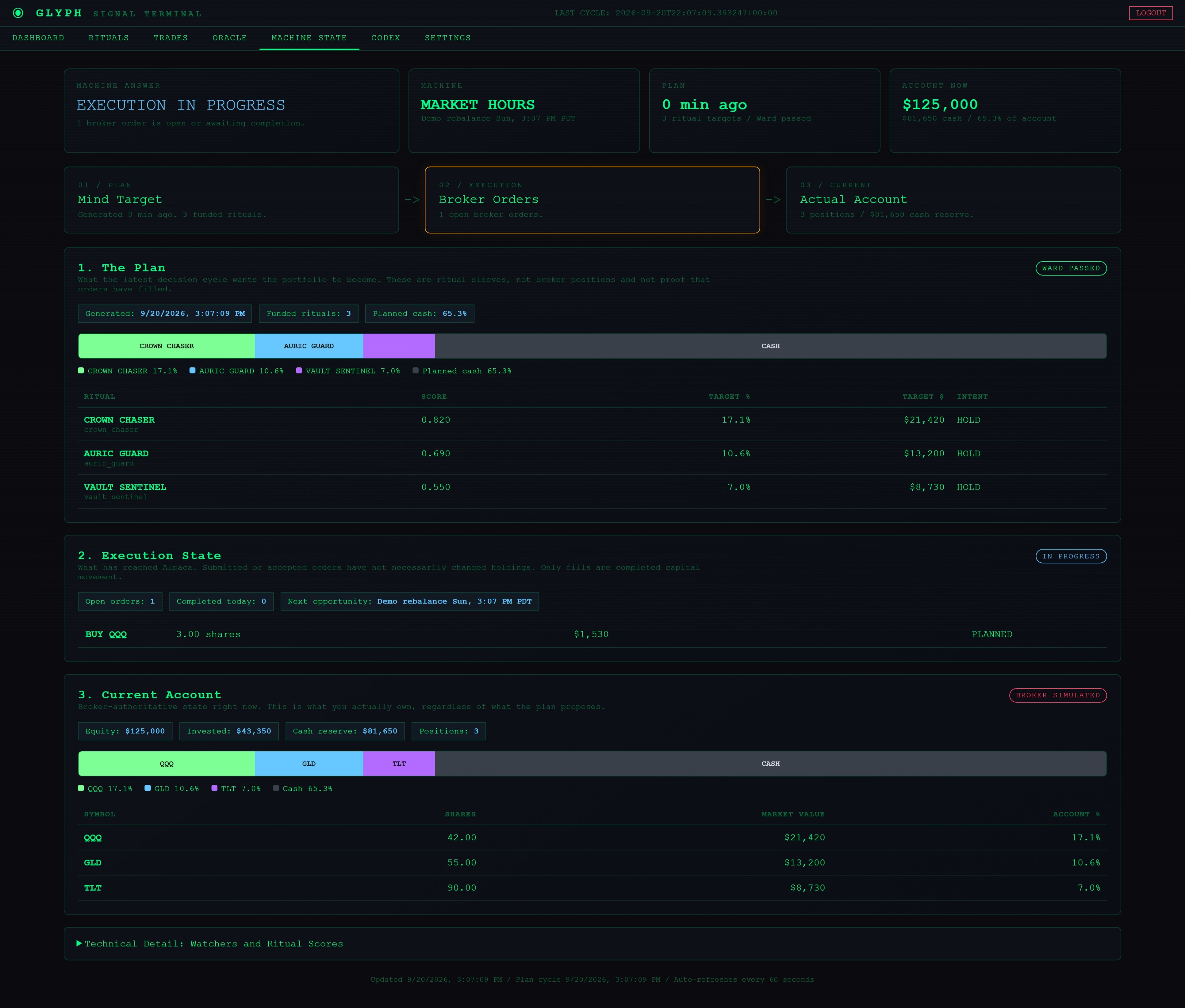
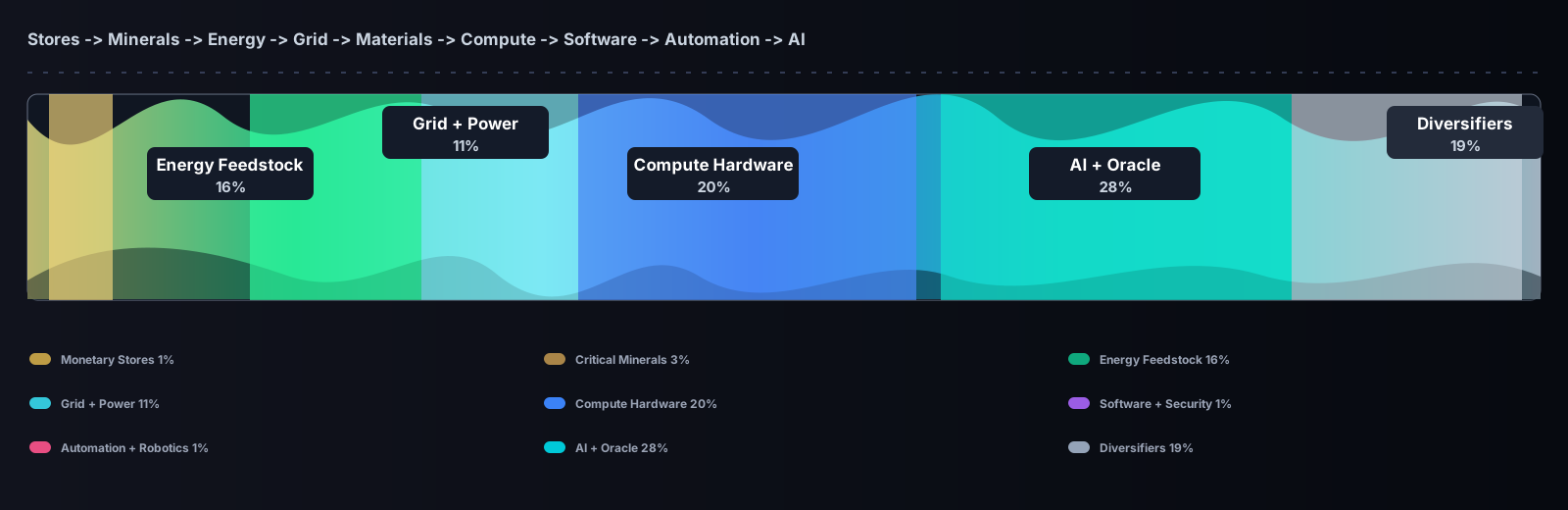
Plan: demo strategy targets remain distinct from broker positions. Passing a Ward does not mean an order has filled.Execution: a demo rebalance separates planned orders, open orders, and completed capital movement.Current account: holdings and cash are reported separately from the plan. This captured account is explicitly broker-simulated.
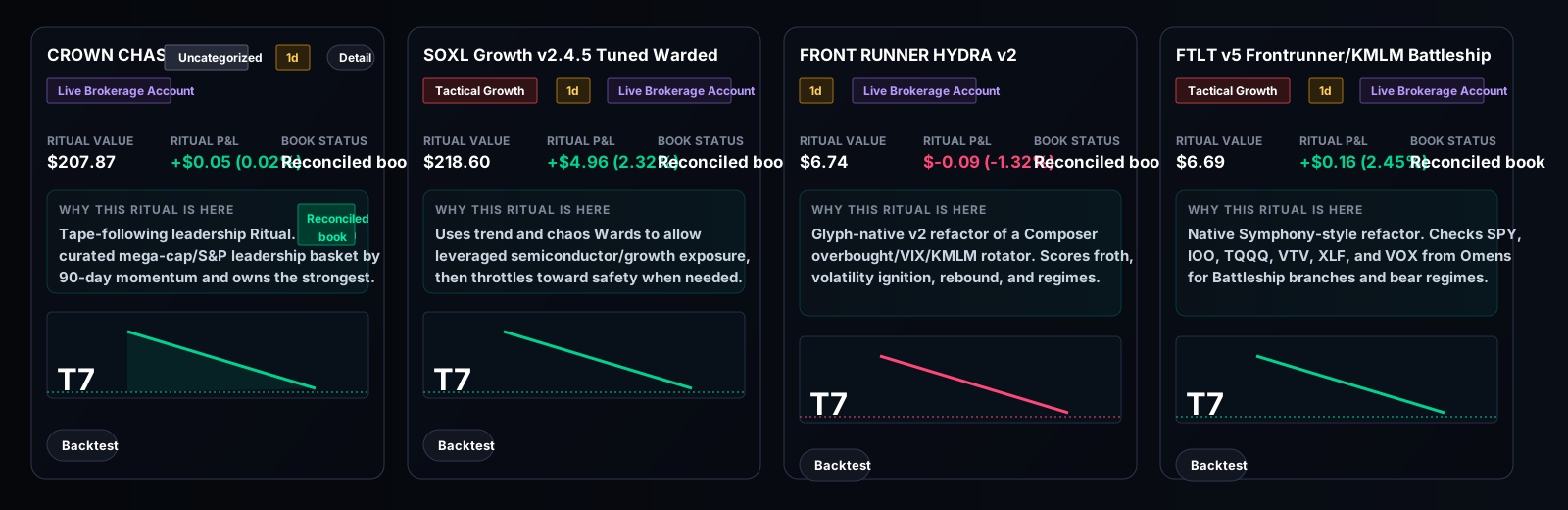
Ritual review surfaceEach sleeve carries its own thesis, broker reconciliation state, PnL, and backtest path instead of becoming anonymous account-level exposure.
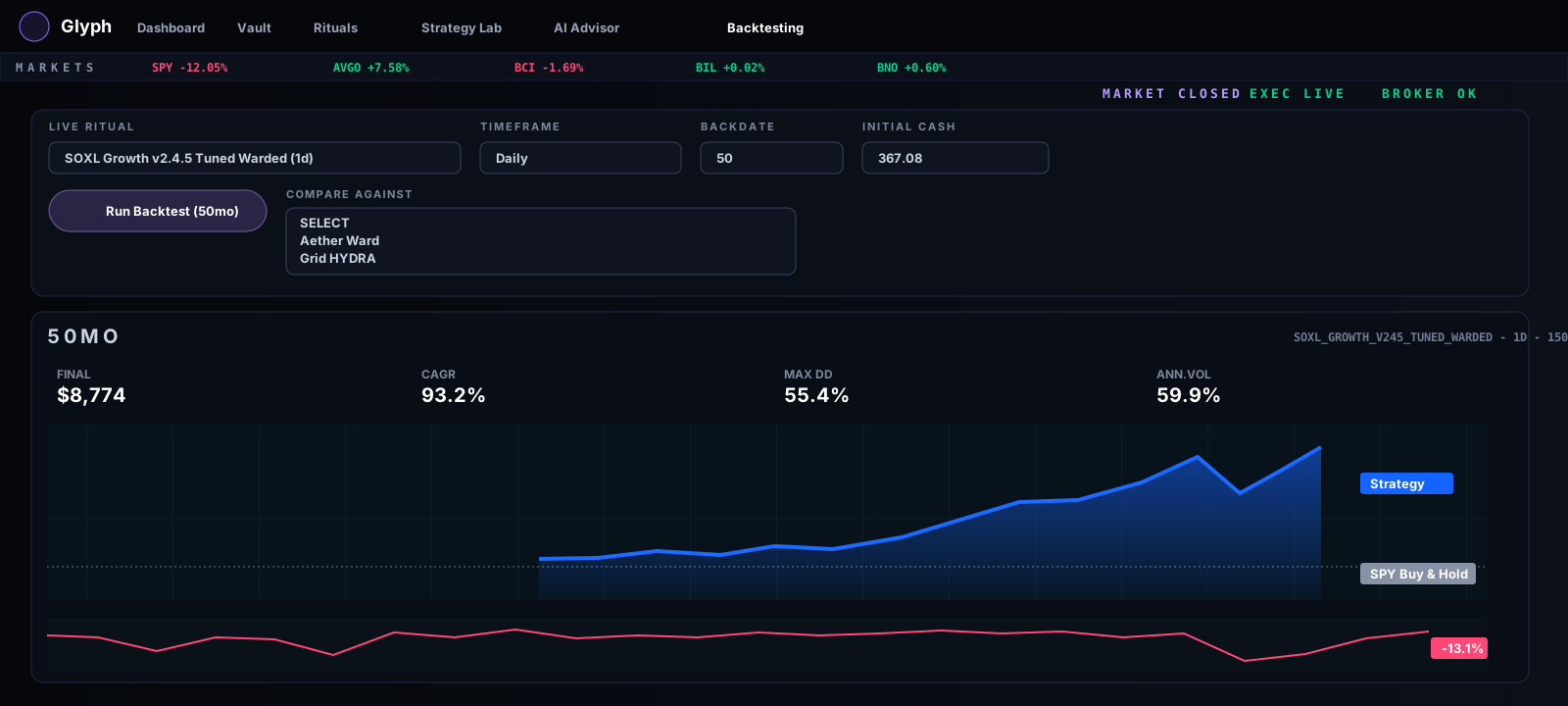
Backtesting and Divination
The backtesting surface tests Rituals before Manifestation. It supports swing, intraday, strategy-block,
cross-asset, and watcher-specific simulations with metrics like CAGR, max drawdown, annualized volatility,
turnover, time under water, PnL, and benchmark comparison.
The strongest design choice is that backtests reuse live-ish planning components where practical. Divinations are
not a toy path beside production; they are a safer rehearsal for the same constraints the operator will face later.
Backtesting labDivinations keep strategy experiments close to the same broker, Ward, and benchmark constraints used by the live operator surface.
Why it matters as a product system
Glyph keeps the mythic language where it helps the operator reason about roles, but the product is built around
practical guarantees: who owns capital, what strategy wants exposure, which risk control blocked a plan, whether
the broker state reconciled, and where proceeds go after harvest or deallocation.
What I built toward
A UI where aggressive autonomous planning can exist beside conservative execution law. The Oracle can be ambitious,
Watchers can scout constantly, and Rituals can express strategy, but Wards, High Seal, Manifestation, ownership,
reconciliation, and Chronicle keep the system inspectable.